On this page
Short answer
The types of mold most often found in homes are Cladosporium, Penicillium, Aspergillus and Alternaria, with Stachybotrys ("black mold") less common and tied to long-term water damage. A survey of 1,717 US buildings found Cladosporium in the indoor air of 86% of buildings and Stachybotrys chartarum in 6%. Color doesn't tell you which mold is riskier, and the CDC says all molds should be treated the same for health risk and removal.
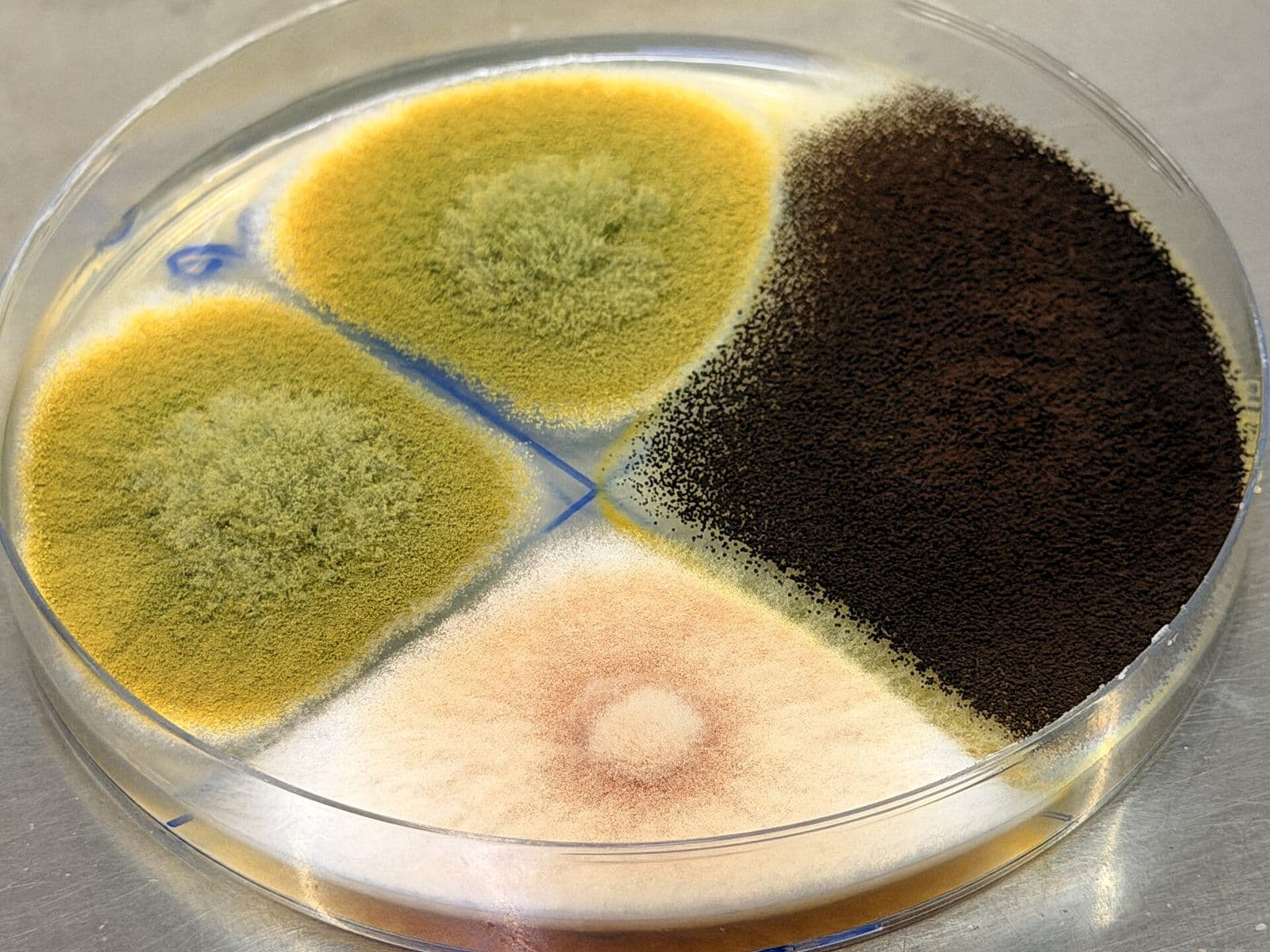
There are many types of mold, but only a handful turn up in homes again and again. Knowing their names helps when you read a lab report or an inspector's notes. It does not change what you should do about the mold, and this guide explains why. Below are the common types of household mold, what the colors you see usually mean, and the pink "mold" in your shower that isn't mold at all.
How many types of mold are there?
A lot. The EPA says there are many species of molds, and its mold course notes that more than one type of mold can be found growing in the same area. You'll usually see molds named by genus, the first part of the scientific name, like Aspergillus.
Two words you'll see online are not types of mold at all. The EPA says plainly that "black mold" is not a species or specific kind of mold, and neither is "toxic mold."
Common types of household mold
The best large US data on indoor mold types comes from a study published in Applied and Environmental Microbiology, which analyzed 12,026 air samples from 1,717 buildings. It found that the most common culturable airborne fungi, both indoors and outdoors and in all seasons and regions, were Cladosporium, Penicillium, nonsporulating fungi and Aspergillus. It also found that indoor fungal levels were lower than those in outdoor air, which is normal for a healthy building.
Types of household mold: the five you'll hear about most
| Mold (genus) | Where it's found | What the research says |
|---|---|---|
| Cladosporium | Outdoors on dead plants or vegetable matter; comes indoors through doors and windows | Found in indoor air in 86% of buildings in the US survey |
| Penicillium | Soil, food and grains, and house dust; water-damaged buildings | Found in indoor air in 80% of buildings; often gives a green "mildew" color |
| Aspergillus | House dust, compost and dead vegetation | Found in indoor air in 62% of buildings; the CDC calls it a common mold |
| Alternaria | Mostly outdoors; one of the common outdoor fungi | Sensitivity is linked to severe asthma attacks in allergic people |
| Stachybotrys | Wet, cellulose-rich materials like drywall and paper | Found in indoor air in 6% of buildings; needs constant moisture |
Table: common indoor mold genera. Sources linked in each cell.
Cladosporium
Cladosporium is everywhere. A 2016 review in the Journal of Allergy and Clinical Immunology: In Practice calls it the most commonly identified outdoor fungus. Because so much of it blows in from outside, finding Cladosporium indoors on its own doesn't prove you have a mold problem. What matters is whether it's actively growing on something wet inside.
Penicillium
Penicillium is a classic indoor mold. The same review says it grows in water damaged buildings, wallpaper, and decaying fabrics, often giving a green "mildew" color. It's one of the molds the review groups with indoor water damage or decay, and in one study of damp buildings it headed the list of genera most frequently encountered indoors, at 68%.
Aspergillus
Aspergillus is very common indoors and out. The CDC says Aspergillus spores are common in indoor and outdoor environments and that most people breathe in Aspergillus spores every day without getting sick. The concern is for specific groups: the CDC says people with weakened immune systems or lung diseases are most at risk of aspergillosis, an infection.
Alternaria
Alternaria is mainly an outdoor mold, but it matters for allergy and asthma. The 2016 review says Alternaria sensitivity has been found to be a risk factor for severe asthma attacks. If someone in your home has mold allergies, that's a conversation for their doctor, not a reason to test your house.
Stachybotrys
Stachybotrys chartarum is the mold most people mean by "black mold." The CDC describes it as a greenish-black mold that grows on material with a high cellulose content, such as fiberboard, gypsum board, and paper. A 2016 study in Analytical and Bioanalytical Chemistry notes it requires high water activity (0.98) for growth, which indoors means water ingress rather than high levels of condensation. In plain terms: if you have Stachybotrys, you have a leak or flood that stayed wet for a long time.
The CDC says that while it's often called "toxic," all molds should be treated the same with respect to potential health risks and removal. Our black mold and is black mold dangerous guides go further.
Mold colors: what green, white, black and pink usually mean
People search by color because color is what they see. Here is what the colors usually point to, and the limits of guessing.
The CDC says mold can look like spots of many different colors. NIOSH adds that the color of mold does not necessarily indicate that it is more or less dangerous. Many different molds share a color, and one mold can look different on different materials. You can't identify a genus by eye.
Mold colors and what they usually are
| Color | Often | Keep in mind |
|---|---|---|
| Green | Penicillium, which often gives a green "mildew" color | Other molds can be green too |
| White | Many molds; the EPA says molds come in many colors including white | Common on wood, leather and in closets; see mildew |
| Black or greenish-black | Many molds; Stachybotrys is greenish-black | Most black spots in showers are not Stachybotrys |
| Pink, red or orange film in bathrooms | Often the bacterium Serratia marcescens, not mold | Cleaned differently from mold; see below |
Table: mold colors. Sources linked in each cell.
Green mold
Indoors on damp building materials, green growth is often Penicillium, which grows in water damaged buildings, wallpaper, and decaying fabrics. Treat it like any other mold: fix the moisture, clean hard surfaces, and remove porous materials that are moldy. See mold on walls.
White mold
White mold is easy to miss because it can look like dust. You may find it on wood in attics and crawl spaces, on furniture, and on leather. It's still mold. See mold in the attic, mold in the crawl space and mold on wood.
Black mold
Most black spots in a home are common molds growing on damp grout, caulk, window frames or drywall. A lab can tell you if it's Stachybotrys, but you rarely need to know. If you're thinking of testing, read black mold test first.
Pink mold (usually not mold)
The pink or reddish film around shower drains, in toilet bowls and on shower curtains is usually not mold. North Dakota State University Extension says it is bacteria known as Serratia marcescens. NDSU says the bacterium will grow in places with materials containing phosphorus or fatty substances, like soap residue, and that the stains are removed easily with a general-purpose cleanser containing chlorine bleach, though the bacteria are hard to get rid of completely. It also warns do not leave bleach sitting in your tank because it damages rubber valves and seals.
NDSU notes the genus has been known to be pathogenic to some people, mostly in hospital settings. For a healthy household, regular cleaning, a squeegee and a running exhaust fan keep it in check. See mold in the shower, mold in the toilet and mold in the bathtub.
Do you need to know which type of mold you have?
Almost never. This is where official guidance is unusually consistent:
- The CDC says you do not need to know the type of mold and that it is not necessary to determine what type of mold you may have growing in your home.
- TDLR says testing to determine what kind of mold is present is not required prior to remediation or cleaning.
- The EPA says that in most cases, if visible mold growth is present, sampling is unnecessary.
The reason is that the response is the same for every type: find the water, fix it, clean or remove the moldy material, and dry everything. A lab name on a report doesn't change any of those steps. Our is mold testing worth it guide covers the cases where testing does help, such as finding hidden mold or confirming a cleanup passed.
What to do about any type of mold
- Find the moisture. The EPA says moisture is the most important factor influencing mold growth indoors.
- Clean small areas yourself. The EPA says you can usually handle an area less than about 10 square feet. Our how to get rid of mold guide has the steps.
- Hire licensed help for bigger jobs. In Texas, TDLR says unlicensed people may generally clean areas less than 25 contiguous square feet. Beyond that, use a licensed mold removal company. If you need the mold found or a cleanup verified, hire a separate mold testing company; Texas law says a license holder may not perform both mold assessment and mold remediation on the same project.
- See a doctor for symptoms. The CDC says people with asthma or who are allergic to mold may have severe reactions. A doctor, not a mold test, diagnoses mold-related illness. See mold allergy.
Check any company's license with our license check, and browse licensed companies across Texas.
FAQ
What are the most common types of mold in homes?
Cladosporium, Penicillium and Aspergillus lead the list. A survey of 1,717 US buildings found them in the indoor air of 86%, 80% and 62% of buildings respectively. Alternaria is common outdoors, and Stachybotrys appears mainly where materials have stayed wet.
What types of household mold are dangerous?
No single type is singled out for different treatment. The CDC says all molds should be treated the same with respect to potential health risks and removal. People with asthma, allergies, weak immune systems or lung disease face more risk from any mold.
Is green mold dangerous?
Green mold is often Penicillium, and it's handled like any other mold. NIOSH says the color of mold does not necessarily indicate that it is more or less dangerous. Fix the moisture and clean or remove it.
Is pink mold actually mold?
Usually not. NDSU Extension says the pink or red film in tubs and toilets is bacteria known as Serratia marcescens. It feeds on soap residue and cleans off with a bleach-containing bathroom cleaner.
What do mold colors mean?
Less than most people think. The CDC says mold can look like spots of many different colors, many molds share colors, and color doesn't show which is riskier. The cleanup is the same whatever the color.
Licensed Mold Pros directory
Find a licensed mold removal company
Removal companies hold a Texas mold remediation license. They remove the mold to a plan written by a separate, licensed testing company.
Sources
- Shelton BG et al., Profiles of Airborne Fungi in Buildings and Outdoor Environments in the United States, Applied and Environmental Microbiology (PMC) (Apr 2002)
- Baxi SN et al., Exposure and Health Effects of Fungi on Humans, J Allergy Clin Immunol Pract (PMC) (2016)
- Došen I et al., Stachybotrys mycotoxins: from culture extracts to dust samples, Analytical and Bioanalytical Chemistry (PMC) (2016)
- CDC: Mold (Sept 26, 2024)
- CDC: Facts About Stachybotrys chartarum (May 29, 2024)
- CDC: Aspergillosis Basics (Oct 1, 2026)
- CDC/NIOSH: Mold Testing and Remediation (reviewed Feb 25, 2025)
- EPA: Mold Course Chapter 1 (accessed Oct 2026)
- EPA: What is the difference between mold and mildew? (accessed Oct 2026)
- EPA: A Brief Guide to Mold, Moisture and Your Home (accessed Oct 2026)
- TDLR: Mold Assessors and Remediators FAQ (accessed Oct 2026)
- TDLR: Help! I have mold (Mold Remediation Consumer Protection) (Jan 2025)
- NDSU Extension: Red Substance in Tub, Toilet Is Bacteria (Aug 9, 2010)
- Texas Occupations Code § 1958.155 (texas.public.law) (accessed Oct 2026)
We link every number, rule and health claim to its source. See our editorial policy.