On this page
Short answer
Mold in toilet bowls usually shows up as a dark ring at the waterline, especially in toilets that sit unused. It cleans off a hard porcelain surface with a toilet brush and cleaner, but if it keeps coming back, the tank is often the source. Not every black ring is mold: the EPA notes that manganese in water causes black to brown color; black staining. Never mix bleach with toilet bowl cleaners.
A moldy toilet looks alarming, but it's one of the easier mold problems to fix. Porcelain is a hard, non-porous surface, so mold can't dig in the way it does in drywall. The real questions are whether the ring is mold at all, whether the tank is reseeding the bowl, and whether there's a leak around the toilet you can't see.
Why mold grows in a toilet
A toilet has standing water, organic material and a dark, closed tank. That's plenty for mold and slime to grow, especially when nobody flushes it for a while.
Bob Vila's toilet guide says that when a toilet is rarely flushed, the standing water can promote mineral buildup, staining, and mold growth. It also warns to be extra careful if you have hard water or if you have a toilet that gets used rarely (for instance, a toilet in a guest room or the basement). The EPA's general point applies here too: places that are often or always damp can be hard to maintain completely free of mold.
Common reasons a toilet keeps getting moldy:
- Infrequent use. Guest bathrooms, vacation homes and the toilet nobody likes.
- A dirty tank. Mold and slime on the tank walls and parts wash into the bowl every flush.
- A humid bathroom. Poor ventilation keeps the whole room damp. See mold in bathroom.
- Mineral buildup. Rough deposits give mold and grime something to cling to.
Black ring in toilet bowl: mold or minerals?
A black ring in toilet bowl water can be mold, mineral staining, or both. The difference matters, because the cleaners are different.
The EPA's guidance on nuisance chemicals in drinking water lists what dissolved metals do. Manganese at its secondary standard of 0.05 mg/L causes black to brown color; black staining; bitter metallic taste. Iron at 0.3 mg/L causes rusty color; sediment; metallic taste; reddish or orange staining.
| Clue | More likely mold or slime | More likely mineral stain |
|---|---|---|
| Comes off with a brush and regular cleaner | Yes | Often not |
| Feels slimy | Yes | No, it's hard or rough |
| Same color stains on sinks, tubs or laundry | Not usually | Yes, points to water minerals |
| Returns within days of cleaning | Often, if the tank is dirty | Builds slowly over weeks |
| Spots above the waterline, under the rim | Common | Less common |
Table: practical clues for telling a moldy toilet from a mineral stain. These are rules of thumb, not a lab test.
If you're on well water and see dark stains on several fixtures, a water test from a certified lab will tell you whether manganese or iron is the cause. That's a water treatment question, not a mold one.
You don't need a mold test for the toilet. The CDC says you do not need to know the type of mold, and the EPA says that in most cases, if visible mold growth is present, sampling is unnecessary.
Black mold toilet: is it dangerous?
"Black mold toilet" is a common search, but a dark ring in a toilet is usually ordinary mold or bacterial slime. Color doesn't identify a species, and you'd clean it the same way regardless.
The CDC notes that for some people, mold can cause a stuffy nose, sore throat, coughing or wheezing, burning eyes, or skin rash. People with allergies or asthma may react more. If you have symptoms you think are related to mold, see a doctor: a doctor diagnoses illness, not a mold test. Our guide is black mold dangerous? covers what the research says.
How to clean a moldy toilet bowl
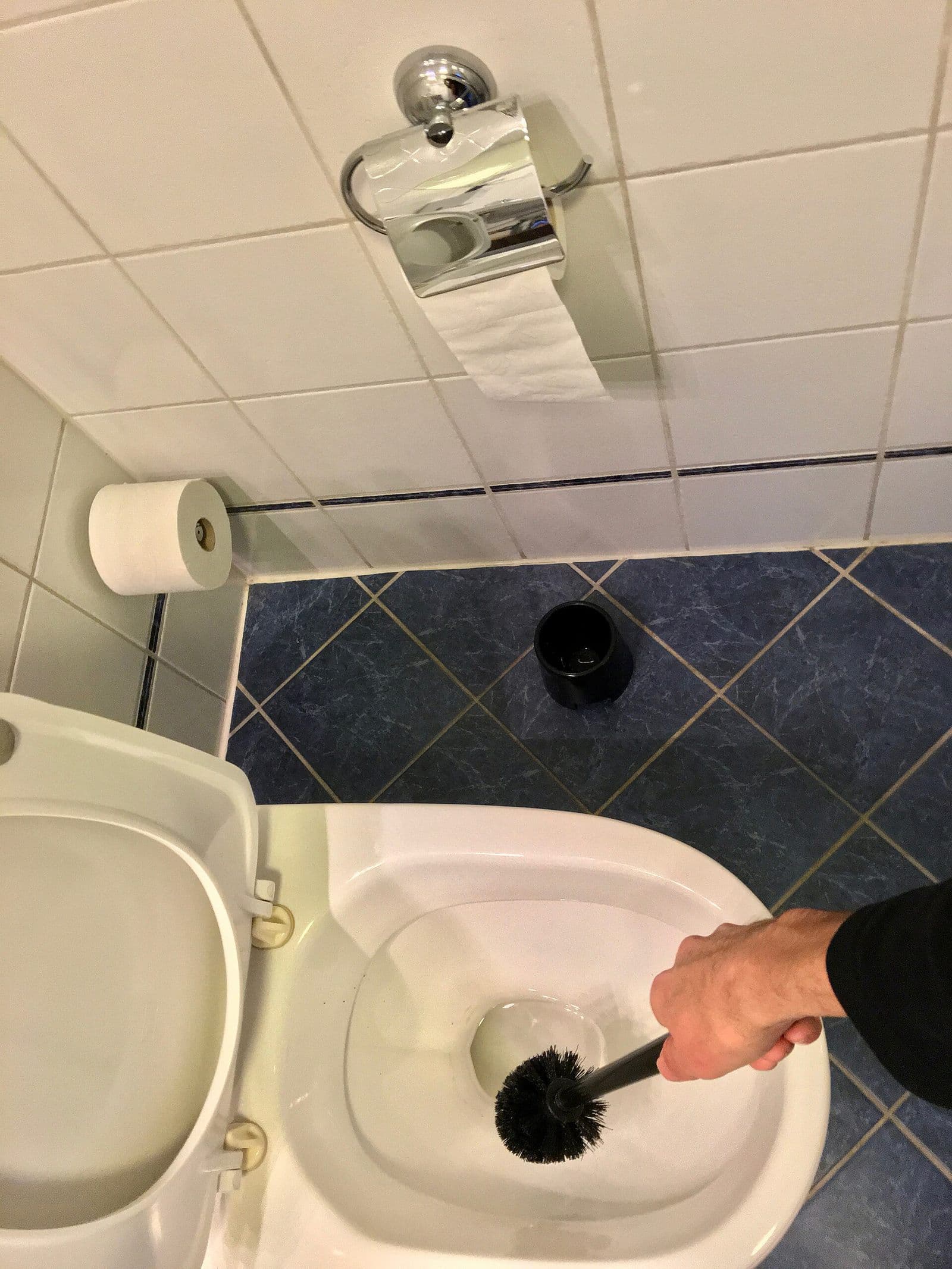
What you need: rubber gloves, a toilet brush, a toilet bowl cleaner or detergent, and eye protection if you're using anything stronger than soap.
- Ventilate. Turn on the fan or open the window.
- Put on gloves. The EPA's basic protective gear for small mold cleanups is gloves, goggles/eye protection and an N-95 respirator.
- Scrub the ring and under the rim. Use a toilet bowl cleaner, or detergent and water, which is the EPA's default: scrub mold off hard surfaces with detergent and water.
- For a mineral ring, an acidic cleaner works better than bleach. Bob Vila notes vinegar is useful against mold and mildew, hard water deposits, and more.
- Flush and check. If the ring is gone and stays gone, you're done. If it's back within days, clean the tank.
Never mix bleach with toilet cleaners
This is the main safety risk in toilet cleaning. The Washington State Department of Health lists toilet bowl cleaners and vinegar among acid-containing products, and says that when chlorine bleach is mixed with an acid, chlorine gas is given off. It also warns that ammonia is found in urine (use caution when cleaning litter boxes, diaper pails, or toilet bowls), and that when bleach is mixed with ammonia, toxic gases called chloramines are produced.
Pick one product. If you switch, flush several times and air out the room first. Our vinegar vs bleach for mold guide explains the trade-offs.
Mold in toilet tank: how to clean it
If the bowl gets moldy again a few days after cleaning, lift the tank lid. Slime and dark growth on the tank walls, flapper or fill valve will keep reseeding the bowl.
Bob Vila's tank-cleaning method, in short (Bob Vila):
- Shut off the water. Locate the shut-off valve, which is usually behind the toilet, toward the base, then flush to empty the tank.
- Soak. Either scrub the tank with a long-handled brush and a little dish soap, or pour in about 4 to 6 cups of white vinegar and let it sit for about an hour.
- Scrub the parts. If slime remains on any of the parts, including the flapper and the fill valve, scrub them with a small brush or a toothbrush.
- Refill and flush a few times to clear the dirty water.
Go easy on chemicals in the tank. Bob Vila says it's important not to use harsh chemicals, and especially not bleach, when you clean the toilet tank. It explains that many tablets as well as commercial toilet bowl cleaners include bleach and other chemicals that can corrode metal parts inside the tank and damage the rubber seals, and that many manufacturers will void warranties if you use in-tank cleaners. Check your toilet's manual before using tablets.
Keeping a toilet from getting moldy again
- Flush unused toilets every few days. Standing water is the main driver in guest bathrooms.
- Clean the bowl weekly and the tank a few times a year.
- Run the bathroom fan. The CDC says to use exhaust fans in the kitchen and bathroom that vent to outside your home.
- Keep humidity down. The EPA recommends indoor humidity below 60 percent (ideally between 30 and 50 percent). On the humid Texas Gulf Coast, that often means running the AC or a dehumidifier.
- Watch for a sweating tank. The EPA explains that when warm, humid air contacts a cold surface, condensation may form. A toilet tank full of cool water can drip onto the floor in humid weather. Wipe it, and keep the bathroom drier.
When a moldy toilet is a sign of a bigger problem
Mold inside the bowl is a cleaning job. Mold outside the toilet is different. Look for:
- Mold or dark staining on the floor around the base
- Soft, spongy or discolored flooring near the toilet
- A musty smell that stays after cleaning
- Stains on the ceiling below an upstairs toilet (see mold on ceiling)
These point to water getting where it shouldn't. TDLR lists over-flowing toilets/sinks/bathtubs among common moisture problems. Toilet overflows are also dirty water: the EPA says that if damage was caused by sewage or other contaminated water, call a professional who has experience with it. The EPA also says to dry water-damaged areas within 24-48 hours to prevent mold growth.
Have a plumber fix the leak. If the subfloor or wall is moldy, that's a removal job. The EPA notes mold can hide inside walls around pipes (with leaking or condensing pipes); see our mold in walls guide.
Who to call in Texas. For the cleanup, use a licensed mold removal company. If you want an assessment of how far it goes, hire a separate mold testing company; Texas law says a license holder may not perform both mold assessment and mold remediation on the same project. TDLR says areas of visible mold less than 25 contiguous square feet can, in most instances, be cleaned by people who aren't licensed. Check any company with our license check or browse listings across Texas.
FAQ
Why does my toilet keep getting moldy?
Usually the toilet isn't flushed often, the tank is dirty, or the bathroom stays humid. Bob Vila notes that when a toilet is rarely flushed, the standing water can promote mineral buildup, staining, and mold growth. Clean the tank, flush regularly and run the fan.
Is a black ring in the toilet bowl mold?
Sometimes. It can also be a mineral stain. The EPA says manganese in water causes black staining. If it's slimy and wipes off, it's likely mold or slime. If it's hard and won't scrub off, minerals are more likely.
Is black mold in toilet bowls dangerous?
A dark toilet ring is usually ordinary mold or slime, and the CDC says you do not need to know the type of mold to clean it. Some people react to mold with allergy-type symptoms. If you're worried about your health, see a doctor.
Can I put bleach in my toilet tank?
Bob Vila advises against it, saying bleach and other chemicals can corrode metal parts inside the tank and damage the rubber seals. Use dish soap or diluted vinegar instead, and check your toilet's manual.
How do I clean mold in a toilet tank?
Shut off the water, flush to empty the tank, then scrub with dish soap or soak with about 4 to 6 cups of white vinegar for an hour. Scrub the flapper and fill valve, then refill and flush a few times.
Licensed Mold Pros directory
Find a licensed mold removal company
Removal companies hold a Texas mold remediation license. They remove the mold to a plan written by a separate, licensed testing company.
Sources
- EPA: Secondary Drinking Water Standards: Guidance for Nuisance Chemicals (accessed Oct 2026)
- EPA: A Brief Guide to Mold, Moisture and Your Home (accessed Oct 2026)
- EPA: What are the basic mold cleanup steps? (accessed Oct 2026)
- EPA: Mold Course Chapter 2 (accessed Oct 2026)
- EPA: Mold Course Chapter 6 (accessed Oct 2026)
- CDC: Mold (Sept 26, 2024)
- Washington State Department of Health: Dangers of Mixing Bleach with Cleaners (accessed Oct 2026)
- Bob Vila: How to Clean a Toilet Tank (updated Sept 13, 2024)
- TDLR: Help! I have mold (Mold Remediation Consumer Protection) (Jan 2025)
- Texas Occupations Code § 1958.155 (texas.public.law) (accessed Oct 2026)
We link every number, rule and health claim to its source. See our editorial policy.