On this page
Short answer
Mold spores are the microscopic "seeds" molds use to spread. The EPA says they are found both indoors and outdoors and that it is impossible to get rid of all mold and mold spores indoors. Spores may remain able to grow for years, and dead or alive they can still trigger allergies. They become a problem when they land somewhere wet and start growing, so the goal is moisture control, not a spore-free house.
Mold spores sound alarming, especially after you've found mold at home. But they're also a normal part of the air you've breathed your whole life. This guide explains what mold spores are, when they matter for your health, how long mold spores live, whether they die, and what actually reduces them in a home. Health information here comes from the CDC, EPA and research indexed by the National Institutes of Health (NIH).
What are mold spores?
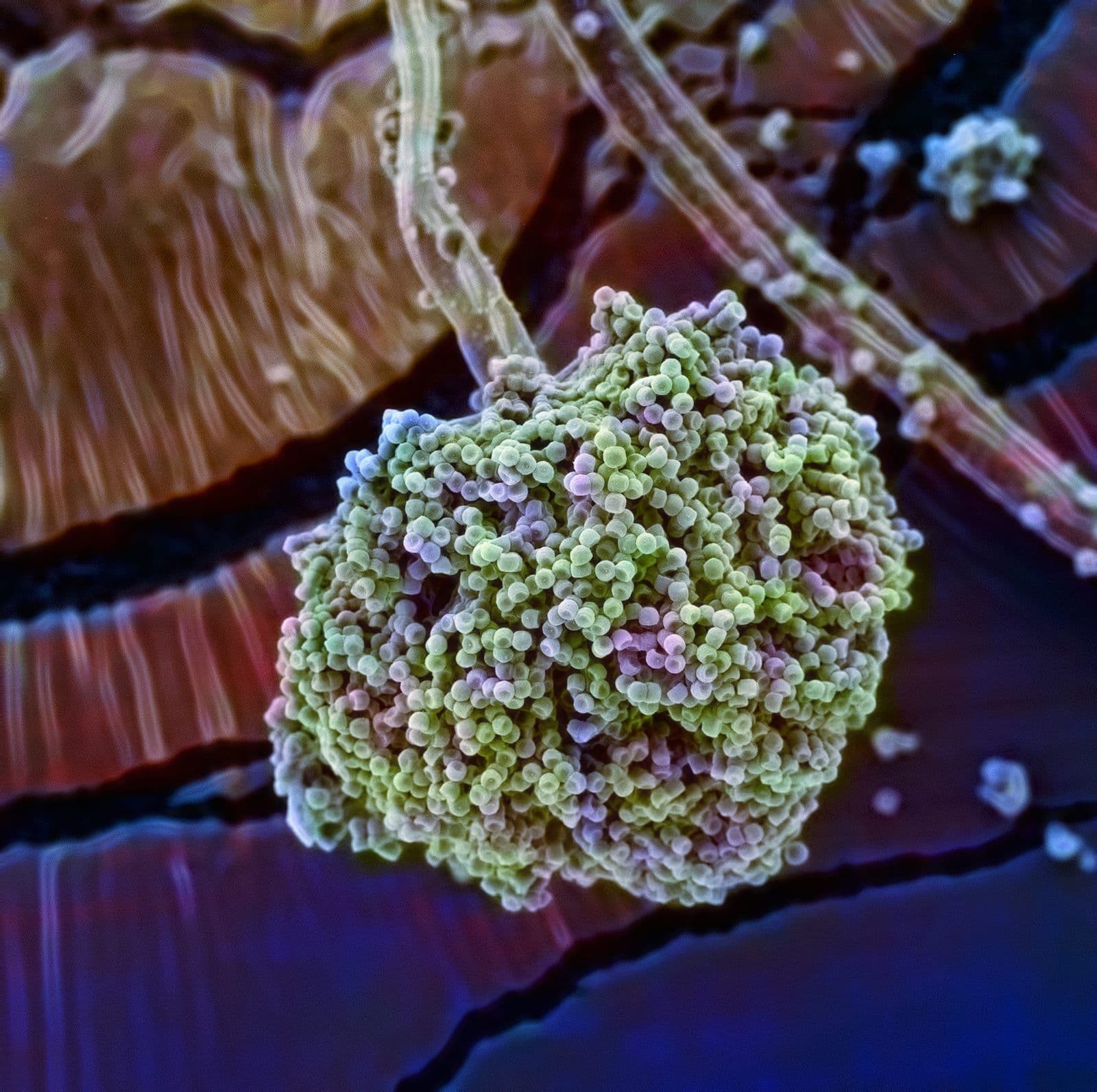
Mold spores are tiny reproductive cells. The EPA says molds multiply by producing microscopic spores (2 - 100 microns [µm] in diameter). The EPA says spores usually cannot be seen without magnification.
TDLR, the Texas agency that licenses mold professionals, describes them as tiny microscopic 'seeds' that are part of the general dust found in homes.
How mold spores spread
Spores travel two ways:
- Through the air. The EPA says many spores are so small they easily float through the air and can be carried for great distances by even the gentlest breezes.
- By sticking to things. The EPA notes that other molds have sticky spores that will cling to surfaces and are released by contact. Stachybotrys, the mold called "black mold," is one: its spores are produced in sticky slime heads and do not easily become airborne when they are moist, according to a 2016 study in Analytical and Bioanalytical Chemistry.
Mold spores are in every home
You can't avoid mold spores entirely. The EPA says mold spores are ubiquitous; they are found both indoors and outdoors, and that the number in the air fluctuates from season to season.
Outdoor air usually has more. A study of 1,717 US buildings published in Applied and Environmental Microbiology found that airborne fungal levels in indoor air were lower than those in outdoor air, with median levels of about 80 colony-forming units per cubic meter indoors and about 500 outdoors. The same study found the most common types, such as Cladosporium and Penicillium, both indoors and out. Our types of mold guide covers them.
When do mold spores become a problem?
Spores alone don't make a mold problem. Growth does. The EPA says spores will not grow if moisture is not present, and the CDC explains that problems start when mold spores drop on places with excessive moisture, such as leaks or flooding.
The EPA calls moisture the most important factor influencing mold growth indoors, and says mold does not need a lot of water to grow; a little condensation can be enough.
That's why Texas homes see so much mold. Humid Gulf Coast air, AC condensation and storm flooding all supply the water spores need. See mold after a flood in Texas and signs of mold in a house.
Are mold spores harmful?
For most healthy people, everyday spore exposure doesn't cause illness. The CDC says, for example, that most people breathe in Aspergillus spores every day without getting sick. Problems are more likely when there is mold growing indoors, and when the person is sensitive.
What the CDC and EPA say about health effects
The CDC says exposure to damp and moldy environments may cause a variety of health effects, or none at all. The EPA lists health risks associated with indoor mold growth including sneezing, runny nose, red eyes, skin rashes, dizziness, headaches and asthma attacks, and says that inhaling or touching mold or mold spores may cause allergic reactions in sensitive individuals.
At a population level, the evidence on damp, moldy homes is consistent. An EPA fact sheet summarizes a 2009 World Health Organization meta-analysis that found building dampness and mold were associated with approximately a 30 to 50 percent increase in a variety of respiratory and asthma-related health outcomes.
Who is most at risk
Are mold spores harmful? Who is at higher risk
| Group | What the CDC or EPA says |
|---|---|
| People with asthma or mold allergies | May have severe reactions (CDC) |
| People with weakened immune systems or chronic lung disease | May get infections in their lungs from mold (CDC) |
| Children, older adults, people with respiratory illness | Risks are especially harmful for these groups (EPA) |
| People with weakened immune systems (Aspergillus) | Most at risk of aspergillosis (CDC) |
Table: higher-risk groups. Sources linked in each cell.
There is no "safe level" of mold spores
Many people want a number. There isn't one. NIOSH says there are no health-based standards for mold or other biological agents in indoor air, and the EPA says no EPA or other federal limits have been set for mold or mold spores. That's one reason the CDC does not recommend mold testing to judge health risk; see is mold testing worth it.
A doctor, not a spore count, decides whether mold is affecting your health. TDLR recommends that people consult a health care provider if they are concerned about mold and their health. Our guides on mold exposure, mold allergy, mold and your lungs and black mold symptoms cover symptoms in more detail.
How long do mold spores live?
Longer than most people expect. The EPA says spores may remain able to grow for years after they are produced. A 2023 review in PLOS Biology describes fungal spores as stress-resistant cell types that can survive extreme conditions, notes that they are dormant, metabolically (nearly) inactive, and reports spores that can stay viable in this state even after 17 years of storage.
In practice, that means spores settled in dust, carpet or an attic can sit quietly until something gets wet. It's why the EPA says to dry water-damaged areas and items within 24-48 hours: the spores needed to start growth are already there.
How long do mold spores live? What the sources say
| Condition | What happens to spores |
|---|---|
| Dry indoor air and dust | They stay dormant; spores will not grow if moisture is not present |
| Over years | May remain able to grow for years |
| Water or high humidity returns | They can start growing; the EPA says to dry water-damaged areas and items within 24-48 hours to prevent it |
Table: spore survival. Sources linked in each cell.
Do mold spores die?
Some do, but it matters less than you'd think, for two reasons.
First, dead spores still cause allergies. The EPA says whether or not the spores are alive, the allergens in and on them may remain allergenic for years, and that dead mold may still cause allergic reactions in some people. Killing mold isn't the goal. Removing it is. The EPA's remediation guidance says it is necessary to clean up mold contamination, not just to kill the mold.
Second, drying stops growth. TDLR says that when the moisture is eliminated, the mold will no longer grow and will die. Spores already released may stay dormant, but without water they can't start new colonies.
What doesn't work:
- Spraying to "kill spores." The EPA says the use of a biocide, such as chlorine bleach, is not recommended as a routine practice during mold remediation.
- Ozone generators. The EPA says ozone at levels within public health standards does not effectively remove viruses, bacteria, mold, or other biological pollutants, and that ozone can be harmful to health.
- Fogging without fixing the water. No product stops spores from growing on a surface that stays wet.
How to reduce mold spores in your home
You can't reach zero, but you can keep spores at normal background levels.
- Control humidity. The CDC says to keep indoor humidity no higher than 50%. The EPA's range is below 60 percent (ideally between 30 and 50 percent). See dehumidifier for mold.
- Dry leaks fast. The EPA's window is 24-48 hours.
- Remove growth carefully. Clean small areas following how to get rid of mold, wearing at least an N95; the CDC says to wear at least a NIOSH Approved N95 respirator.
- Use HEPA for cleanup. The EPA recommends HEPA vacuums for final cleanup of remediation areas. See HEPA vacuums for mold and air purifiers for mold.
- Clean belongings. TDLR says items without mold growth can be kept but may need a deep cleaning to remove mold particles (spores) that have settled in fabric.
- Don't run a moldy HVAC. The EPA says a contaminated system could spread mold throughout the building. See mold in AC vents.
When to call a professional
If growth covers more than about 10 square feet, the EPA points to professional cleanup, and in Texas, TDLR says unlicensed people may generally clean only areas less than 25 contiguous square feet. Larger jobs go to a licensed mold removal company. If you need hidden mold found or a cleanup checked, hire a separate mold testing company; Texas law says a license holder may not perform both mold assessment and mold remediation on the same project. Check any license with our license check, or browse companies across Texas.
FAQ
What are mold spores?
They are the microscopic reproductive cells molds use to spread, 2 - 100 microns across according to the EPA. They float in air and settle in dust, and they're present in every home. They only grow into mold where there's moisture.
Are mold spores harmful?
Everyday exposure usually isn't; the CDC says most people breathe in Aspergillus spores every day without getting sick. Mold growing indoors can cause allergy and asthma symptoms in sensitive people, and infections in people with weak immune systems or lung disease. See a doctor if you have concerns.
How long do mold spores live?
For years. The EPA says spores may remain able to grow for years after they are produced, and a 2023 PLOS Biology review reports spores that can stay viable in this state even after 17 years of storage.
Do mold spores die?
Some do, but dead spores still matter: the EPA says the allergens may remain allergenic for years whether or not the spores are alive. That's why mold should be removed, not just killed, and why drying the area is what stops new growth.
Can you get rid of all mold spores in a house?
No. The EPA says it is impossible to get rid of all mold and mold spores indoors. The realistic goal is to stop growth by controlling moisture so spores stay at normal background levels.
Licensed Mold Pros directory
Find a licensed mold testing company
Testing companies hold a Texas mold assessment license. They inspect, sample and write the removal plan, and by law they can't do the removal on the same job.
Sources
- EPA: Mold Course Chapter 1 (accessed Oct 2026)
- EPA: What are molds? (accessed Oct 2026)
- EPA: A Brief Guide to Mold, Moisture and Your Home (accessed Oct 2026)
- EPA: Mold Cleanup in Your Home (accessed Oct 2026)
- EPA: Mold Testing or Sampling (accessed Oct 2026)
- EPA: Mold Remediation in Schools and Commercial Buildings, Chapter 3 (accessed Oct 2026)
- EPA: Ozone Generators that are Sold as Air Cleaners (accessed Oct 2026)
- EPA: The Environmental Relative Moldiness Index (ERMI) fact sheet (Sept 2021)
- CDC: Mold (Sept 26, 2024)
- CDC: Mold Clean Up Guidelines and Recommendations (Feb 16, 2024)
- CDC: Aspergillosis Basics (Oct 1, 2026)
- CDC/NIOSH: Mold Testing and Remediation (reviewed Feb 25, 2025)
- Seekles SJ, The breaking of fungal spore dormancy: A coordinated transition, PLOS Biology (PMC) (2023)
- Shelton BG et al., Profiles of Airborne Fungi in Buildings and Outdoor Environments in the United States, Applied and Environmental Microbiology (PMC) (Apr 2002)
- Došen I et al., Stachybotrys mycotoxins: from culture extracts to dust samples, Analytical and Bioanalytical Chemistry (PMC) (2016)
- TDLR: Help! I have mold (Mold Remediation Consumer Protection) (Jan 2025)
- Texas Occupations Code § 1958.155 (texas.public.law) (accessed Oct 2026)
We link every number, rule and health claim to its source. See our editorial policy.